
Ladies, your core is more than just six-pack abs - it’s key for posture, strength, and power in every movement. A strong core boosts endurance and helps you hit new personal bests, so make ab work a regular part of your routine.
The best part? You don’t need fancy equipment - just a mat, some floor space, and a timer. For a change of scenery, visit your nearest Village Health & Wellness Club to take your workouts up a notch.
In this article, Antonia Molyneux, Group Fitness Manager at Village Health & Wellness Club in Ashton, explains the core muscles, their benefits, and shares a simple core workout for women to do at home or in the gym.
Quick Summary
-
The core is made up of four key muscles that support your spine and stability.
-
Strong abs improve posture, balance, performance, and help prevent lower back pain.
-
Effective training targets the entire core - not just the “six-pack” muscles.
-
Progress by increasing time, reps, or resistance while maintaining proper form.
-
Consistency, good nutrition, and recovery are essential for real, lasting results.
What is the Core?
Now it’s time to get to know the muscles in your core. There are four main ab muscles you need to focus on targeting when working out, including:
-
External obliques: are the outer layer of abs on your sides which run diagonally downwards.
-
Internal obliques: are the opposite as they lie just underneath your externals and run diagonally up your sides.
-
Rectus abdominis: are the two sheets of muscle that flex forward from your ribs to your pelvis (aka ‘6 pack’ muscles).
-
Transversus abdominis: are the deepest ab muscles which wrap around the waist to give support to your spine.
Therefore if you’re new to fitness or new to working abs, you will need to try and target all of these muscles when working out. Don’t worry though, people often forget that when you’re performing compound exercises you’re engaging your core.
Benefits of Core Workouts
Ab building is so much more than physical aesthetics, strong abdominals can help you perform everyday tasks with more ease and improve your overall health and wellbeing.
Let’s talk you through some benefits of strong abs:
-
Better posture: Strong abs help maintain proper pelvis alignment and keep your spine supported throughout daily activities.
-
Lower back support: A strong core stabilises your spine, reducing the risk of lower back pain.
-
Improved balance: Your muscles work together to stabilise your spine and pelvis, helping you stay steady in motion.
-
Enhanced sports performance: A coordinated core allows you to generate more strength and power efficiently.
-
Improved breathing: Strong core muscles support better breath control, helping you engage your body more effectively.
Become the best version of yourself and start prioritising your core strength because the benefits outweigh the short term pain of an ab circuit.
Whether you’d prefer to pick a spot in your living room, or grab a space and yoga mat at your local Village Health & Wellness Club, our ab circuit is perfect for beginners and gym addicts.
We’ve listed our favourite ab exercises below to help you improve your overall strength and wellbeing.
Top Core Workouts for Women
Strengthening your core isn’t just about aesthetics - it improves posture, balance, and overall strength.
Here are some of the best core exercises for women, broken down by difficulty level.
1. Deadbug (Beginner)
Deadbugs strengthen your deep abdominal muscles, which act like a natural corset around your spine. To perform them, slowly lower opposite arms and legs while keeping your core tight.
How to: Lie on your back with arms extended toward the ceiling and knees bent at 90°. Slowly lower the opposite arm and leg toward the floor while keeping your lower back pressed into the mat. Return to start and switch sides.
2. Bird-Dog (Beginner)
Bird-Dogs target your spinal stabilisers and core muscles that help keep you upright. In this exercise, you reach one arm forward and the opposite leg back while balancing on all fours.
How to: Start on all fours. Extend your right arm forward and left leg back until both are parallel to the floor. Hold briefly, then switch sides.
3. Heel Taps (Beginner)
Heel Taps strengthen the lower abdominal muscles, which help support your pelvis and lower back. Perform the exercise by alternately tapping each heel while maintaining a tight core.
How to: Lie on your back with knees bent and feet flat. Lift your head and shoulders slightly off the mat and gently tap each heel alternately.
4. Glute Bridges (Beginner)
Glute Bridges target your glutes and lower back while engaging your core for stability. In this exercise, you lift your hips while squeezing your glutes.
How to: Lie on your back with knees bent, feet hip-width apart. Press through your heels to lift your hips toward the ceiling, squeezing your glutes at the top. Lower slowly.
5. Plank Variations (Intermediate)
Planks target your entire core, including abs, back, and stabilisers. Hold your body like a straight board while keeping your core tight.
How to: Try forearm plank, high plank, or plank with shoulder taps. Keep your spine neutral and core tight.
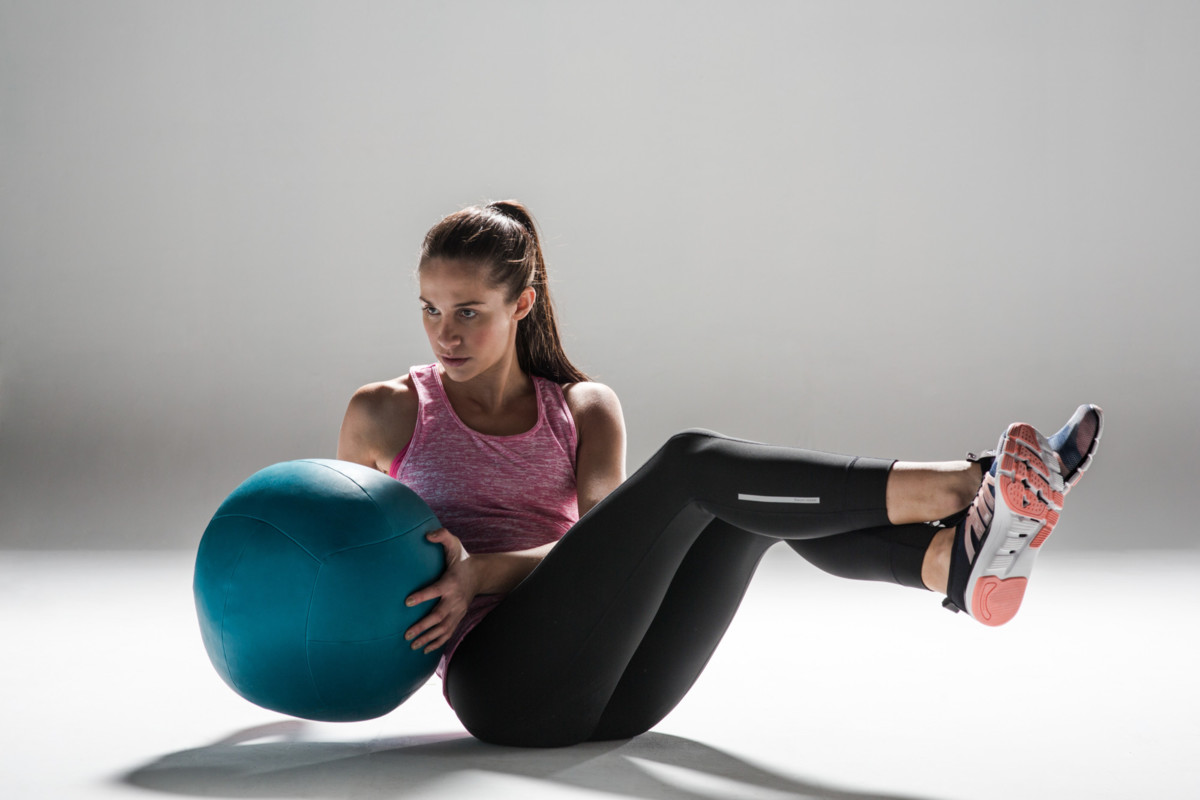
6. Russian Twists (Intermediate)
Russian Twists target your obliques - the muscles along the sides of your waist. In this exercise, you twist your torso from side to side while keeping your core engaged.
How to: Sit with knees bent, heels on the floor or lifted, and lean back slightly. Twist your torso side to side, touching the floor or a weight.
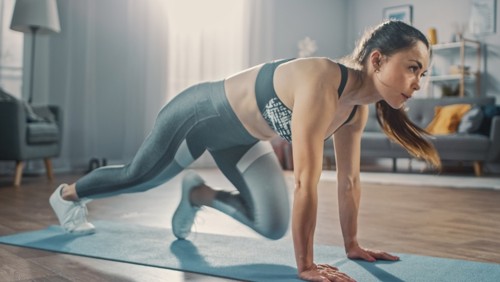
7. Mountain Climbers (Intermediate)
Mountain Climbers target your abs, hip flexors, and shoulders for a full-body burn. Essentially, you’re running in a plank position while keeping your core tight.
How to: Start in a high plank position, hands under shoulders, body in a straight line. Drive your knees toward your chest in a running motion while keeping your hips low.
8. Side Planks (Intermediate)
Side Planks work your obliques and shoulder stabilisers. In this exercise, you stack your body on one side and lift your hips to form a straight line.
How to: Lie on your side, propping yourself on your forearm. Stack your feet and lift your hips to form a straight line from head to toe. Hold, then switch sides.
9. Hanging Leg Raises (Advanced)
Hanging Leg Raises work your lower abs and hip flexors. Lift your legs from a hanging position to challenge your core.
How to: Hang from a pull-up bar and lift your legs straight in front of you to hip height or higher. Lower slowly.
10. Ab Wheel Rollouts (Advanced)
Ab Wheel Rollouts target your entire core, especially your deep stabilisers. You roll the wheel forward and back while keeping your body under control.
How to: Kneel with an ab wheel in your hands. Roll the wheel forward, keeping your core engaged, then pull back to the starting position.
Core Workout Routine for Beginners
-
Sit ups
-
Bicycle crunches
-
Jackknife
-
Leg raises
-
Russian twists
-
Plank
Looking for a beginner core workout for women? Check mate. Try out our ready-made 12 minute ab attack. Prepare to feel the burn but remember, the pain is only temporary, the results are worth it. Plus, you don’t need any equipment!
Perform each exercise for 45 seconds and give yourself 15 seconds to recover before going into the next one. Once you’ve completed all six listed above, give yourself a 30 second rest and then do the circuit again!
Sit Ups
Let’s start by working your torso and put your external obliques, hip flexor and quads under pressure. Sit ups should be controlled so please don’t use your arms to thrust yourself to the top, engage your core.
How to sit up:
-
Grab a gym mat and space on the floor.
-
Lie with your back, glutes and feet pressed to the floor and your legs bent.
-
Place your hands on either side of your head, just behind your ears.
-
Squeeze your core, bend your hips and waist to help raise your body from the floor.
-
When you reach your knees, begin to lower your body back down into the starting position slowly and then repeat.
Bicycle Crunches
Bicycle crunches will target your rectus abdominis muscle, the upper abs which we all know as the six-pack muscles. Basically we want you to cycle horizontally.
How to bicycle crunch:
-
Press your lower back flat into the mat.
-
Now lift your knees up to form a 90 degree at your hip and knee.
-
Place your hands behind your head, then crunch your stomach and bring your right elbow towards your left knee and extend your right leg.
-
Alternate sides by bringing your left elbow towards your right knee and extend your left leg.
-
That’s 1 rep. Now keep going until the 45 seconds is up.
Jackknife
Keep the pressure on your abs whilst we perform the Jackknife which is a core exercise designed to strengthen the upper and lower ab muscles, specifically the transverse ab muscles.
How to jackknife:
-
Lie on the floor with your arms and legs stretched out.
-
Engage your core, slightly raise your arms and legs off the floor with your knees slightly bent.
-
Then curl your body so you bring your arms up and over towards your knees, whilst you bring your knees up towards your torso - they should meet above your abs.
-
Slowly ease back down to the starting point but don’t lie flat on the floor, stay elevated with your arms and legs slightly hovering to keep the tension until you’ve finished your rep. And repeat.
Leg Raises
Leg raises are often incorporated into ab routines as they help strengthen your rectus ab muscles as well as your internal and external obliques.
How to leg raise:
-
Press your back on the floor with your arms by your side, palms down and legs out straight (some people like to put their hands under their glutes too).
-
Push your stomach into the floor to keep your back flat then, engage your core and slowly raise your legs simultaneously.
-
Aim to stretch your legs up towards the ceiling, keeping your toes pointed.
-
Once you’ve reached as high as you can, lower your legs back down in a smooth and controlled movement.
-
Stop before they reach the ground. That’s 1 rep, repeat.
Russian Twists
Russian twists will kill your obliques - just a forewarning! This ab exercise can be performed with a weight plate or dumbbell if you’d like to challenge yourself.
How to Russian twist:
-
Start by sitting on the mat with your feet in front of you and your knees bent. If you’re using a weight, hold this in front of your chest.
-
Lift your feet off the floor and keep your knees bent.
-
Keep a tall spine, lean your torso back so you’re at a 45 degree angle from the floor and 90 degrees from your thighs.
-
Use your arms to twist your body to the left, tapping your finger tips or weight plate on the floor.
-
Twist back to the centre and then continue to the right.
-
Again, twist back to the centre. This is one rep, repeat.
Plank
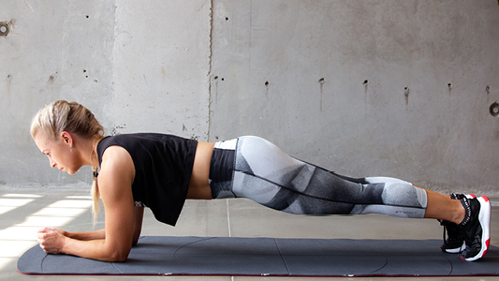
Last but not least in our ab circuit. The plank is a bodyweight exercise that targets muscles all across your body including your abs, back, shoulders and glutes all at once. So engage your muscles in harmony and stay centre and static.
45 seconds may be a struggle to begin with especially if you’re a beginner, so it’s ok to start with 30 seconds.
How to plank:
-
Start on all fours, then place your forearms on the floor, shoulder width apart so your elbows are stacked beneath your shoulders.
-
Tighten your core then step both legs back behind you to create a straight line from your feet to your head, hip width apart and tuck your tummy in.
-
Now keep your core, butt, quads engaged until the timer goes off.
If you’re completely new to core work, you may also want to start with our guide to core exercises for beginners before diving into this routine.
How to Progress Your Core Workouts
Once you’ve mastered the basics, progressing your core workouts is key to continued strength, stability, and definition. Here are some ways to level up your training:
1. Increasing Reps, Sets, or Duration
Gradually challenge your muscles by performing more repetitions, adding extra sets, or holding static exercises like planks for longer. Small, consistent increases keep your core improving without overloading it.
2. Adding Resistance
Introduce resistance to make your core work harder. Use resistance bands, dumbbells, or medicine balls during exercises like Russian twists, leg raises, or glute bridges. Resistance helps build strength faster and enhances muscle tone.
3. Combining with Functional Movements
Incorporate core exercises into movements you perform in daily life or sports. Think lunges with a twist, kettlebell swings, or medicine ball slams. This trains your core to stabilise and support real-life movements, improving strength and coordination.
Common Mistakes to Avoid When Training Your Core
Even small errors can reduce the effectiveness of core training or risk injury. Watch out for these common mistakes:
-
Over-relying on crunches: Crunches mainly target the front of your abs and neglect deeper stabilisers. Mix in other exercises like planks, bird-dogs, and glute bridges for a balanced core.
-
Holding your breath: Breathing is essential for maintaining tension and protecting your spine. Exhale during exertion and inhale during release to maximise control and safety.
-
Neglecting glutes and back: The core isn’t just abs - your glutes, lower back, and obliques all work together. Skipping these muscles limits results and increases risk of back pain.
-
Poor posture/form: Rushing exercises or letting your back arch reduces effectiveness and can cause injury. Focus on controlled, quality movement rather than speed or quantity.
Tips for Getting the Best Results
Strong abs come from more than just exercises - they’re built through consistency, lifestyle, and smart recovery.
1. Consistency & Frequency
Aim to train your core 3-4 times per week. Short, focused sessions are more effective than infrequent, long workouts.
2. Incorporating Core in Everyday Activities
Engage your core during daily movements: standing, walking, lifting, or even sitting at your desk. Constant activation strengthens your stabilisers over time.
3. Nutrition and Recovery Basics
Abs are made in the kitchen as much as the gym. Eat a balanced diet with sufficient protein, stay hydrated, and give your muscles time to recover. Adequate rest prevents fatigue and helps muscles grow stronger.
Core Workouts For Women FAQs
Do core exercises burn belly fat?
In short, core exercises alone will not burn belly fat, that’s a myth. The only way to reduce stomach fat is to reduce overall body fat and then tone your ab muscles through strength training.
What is the best overall core exercise?
This is personal to you. Strength training your full body will engage and strengthen your core and additional ab circuits will help put pressure on your different ab muscles.
How can a woman strengthen her core?
To strengthen your core, you will need to be patient and consistent with your strength and resistance training. Be prepared to switch up your core workout and target different abdominals.
Boost Your Core at Village Health & Wellness
Village Health & Wellness Clubs are here to help you take your core strength to the next level. Our Les Mills CORE classes are designed to strengthen, tone, and stabilise your core in just 30 minutes.
Using a combination of bodyweight exercises, resistance tubes, and weight plates, these workouts target your abs, back, and surrounding muscles to improve strength, stability, endurance, and overall balance. Suitable for all fitness levels, each session is led by trained instructors who ensure you get the most out of every move.