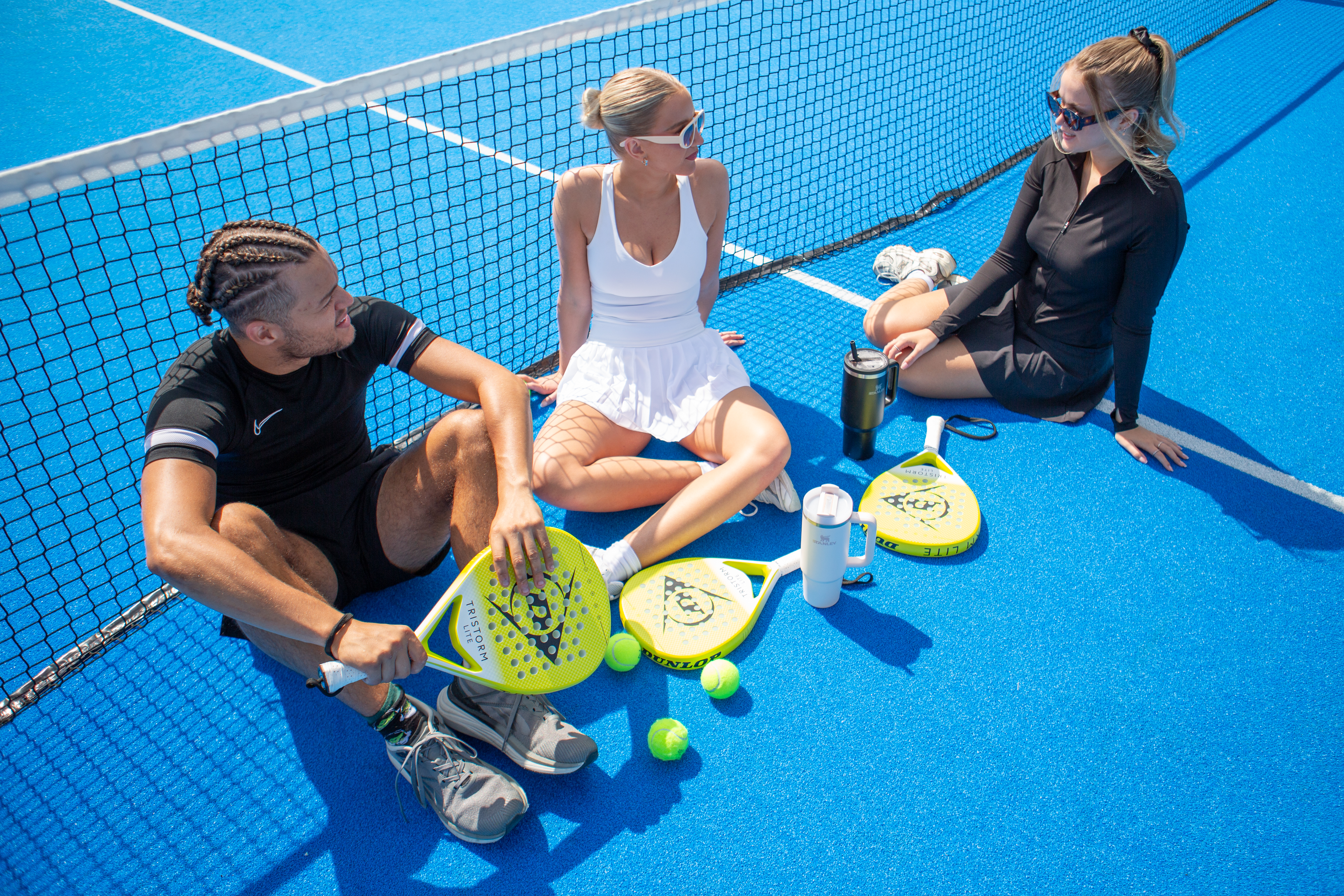
If your social feeds are suddenly full of padel courts, post-match selfies and people claiming they've found their new favourite sport, you're not imagining it. Padel is one of the fastest-growing sports in the world, and it's officially having a moment. From celebrities picking up a racket to courts filling up across the UK, everyone's getting in on the action. And now, you can too. With padel at Village Gym, there's never been a better time to give the sport everyone's talking about a go. No tennis background? No problem. Whether you're looking for a new way to get active, a reason to round up your mates or something different from your usual gym routine, padel could be right up your street.
What is Padel?
Think tennis, meet squash, add a few mates and you've got padel.
Padel is a racket sport played in doubles on an enclosed court that's smaller than a traditional tennis court. You'll use a solid, perforated racket rather than a stringed one, alongside a lower-pressure ball similar to a tennis ball. The biggest difference? The walls are part of the game.
Just like squash, you can play the ball off the back and side walls, opening up a whole new level of angles, tactics and unexpected comebacks. A shot that looks like it's heading out could be the perfect opportunity to keep a rally going. Suddenly, you're not just hitting the ball back and forth; you're thinking on your feet, working with your partner and figuring out your next move.
Here's what makes padel stand out:
It's doubles all the way. You'll always play with a partner against another pair, making it a naturally social sport.
The court is smaller. There's less ground to cover than in tennis, so you can focus on the game without needing to sprint across a huge court.
The walls change everything. Use them to your advantage and keep the rally alive when a ball would otherwise be out of reach.
Strategy beats brute force. Smart positioning, clever angles and teamwork can be just as effective as a powerful shot.
And the best bit? You don't need years of practice to enjoy it. Padel is easy to get started with, but there's plenty of room to improve your skills as you play more.
It's a workout, a friendly competition and a catch-up with your mates rolled into one. What's not to love?
Padel vs Tennis: Why Padel is Easier to Start
Ever watched a game of tennis and thought, "Absolutely not"? We get it. Between powerful serves, long rallies and players covering every inch of the court, tennis can look pretty intimidating if you're starting from scratch.
But here's the thing: if you can't play tennis, that doesn't mean you can't play padel.
Although the two sports share some similarities, padel is often more approachable for beginners. The smaller court, underarm serve and walls give you more opportunities to get involved, even if your racket skills are still a work in progress.
Here's how they compare:
Less running, more playing: A padel court is considerably smaller than a tennis court, meaning there's less ground to cover. You'll still get your heart rate up, but you won't need to chase every ball across a massive playing area. It's a great way to get moving without every point turning into an all-out sprint.
More time to react: Padel uses a lower-pressure ball, which generally moves more slowly than a standard tennis ball. Combined with the smaller court, this can give beginners more time to react, find their position and return a shot.
The walls are your friend: In tennis, a ball that gets past you can mean game over. In padel, the walls give you another opportunity to play your shot after the ball bounces on your side of the court. Learning how to use them is part of the fun, and it can help keep rallies going for longer.
You don't need a powerful serve: Forget trying to smash an unstoppable serve down the court. Padel uses an underarm serve, so power isn't the main event. Placement, control and knowing where to put the ball can make all the difference.
It's all about teamwork: Because padel is always played in doubles, you're sharing the court with a partner. Communication, positioning and working together are just as important as individual ability.
Of course, tennis players can bring plenty of useful skills to the court, too. But you don't need to be one to get started.
If you're looking for a new sport that feels achievable from your first session, padel is well worth a try.
Why is Padel the Fastest-Growing Sport Right Now?
So, why is everyone suddenly playing padel? And how did a sport that many people hadn't heard of a few years ago become one of the biggest talking points in fitness?
It's a combination of accessibility, social appeal and serious trend momentum.
The numbers are growing
Padel isn't just having a moment on social media. According to the Lawn Tennis Association (LTA), 860,000 people in Britain had played padel in the previous year, as reported in its March 2026 update. The LTA has identified padel as the fastest-growing sport in the UK, reflecting just how quickly interest has taken off.
More people are discovering the game, more facilities are opening and more players are looking for courts in their local area.
It's all over your social feeds
From celebrities showing off their skills to creators sharing their first-session experiences, padel has become a familiar sight on Instagram and TikTok.
Even Tom Holland has been spotted playing. And with professional tournaments attracting more attention and padel coverage reaching new audiences, the sport is becoming increasingly visible beyond its established fanbase.
It's the kind of activity that makes you think, "That looks fun. I want to give it a go."
It's a workout that doesn't feel like a workout
Don't get us wrong, there's plenty of movement involved. Padel combines bursts of speed, quick reactions, coordination and sustained rallies to deliver a full-body workout that can get your heart pumping.
But because you're focused on the ball, your partner and the game, it doesn't necessarily feel like a traditional workout. You're not counting down the minutes on a treadmill or watching the clock between sets. You're too busy trying to win the point.
It's social by design
One of padel's biggest selling points is that it's built around playing together. You need four players for a doubles match, which makes it a great way to spend time with friends, meet new people or find a new shared hobby.
It's also a brilliant option if your usual gym routine is starting to feel a little repetitive. Swap a solo session for some friendly competition and you've got a new reason to get moving.
It is competitive when you want it to be
Some people love tracking their progress, improving their technique and chasing the win. Others just want a laugh, a decent rally and an excuse to get everyone together.
Padel works for both. You can take it seriously, play casually or find your feet somewhere in between.
And if you're wondering how it compares with pickleball, both sports offer a social, accessible alternative to traditional racket sports. However, they have different court layouts, equipment and rules. Padel's enclosed court and playable walls give it a distinctive style, with rallies that reward teamwork and tactics.
Ultimately, the appeal is simple: padel makes being active feel less like another task on your to-do list and more like something you actually want to do.
How to Play Padel: Rules and Scoring
Never played before? Don't worry. You don't need to memorise a rulebook before stepping onto the court. Once you understand the basics, you'll be ready to get involved.
How does a padel match work?
Padel is played in doubles, with two players on each side of the net. The aim is to get the ball into your opponents' court in a way that prevents them from returning it legally.
You can hit the ball before it bounces (a volley) or after it bounces once. The ball can also rebound off the walls after bouncing on the court, creating opportunities to keep a point alive.
If the ball bounces twice on your side before you return it, you lose the point. You can also lose a point by hitting the ball into the net or sending it out of play without a legal return.
How do you serve in padel?
Unlike tennis, padel serves are underarm. You'll let the ball bounce once and hit it below waist height, sending it diagonally into the opposite service box.
The serve must land in the correct service box, and the rules allow the ball to bounce off the glass after landing. However, if it hits the fencing directly after the bounce, the serve is a fault.
Each player gets two attempts to make a valid serve, just like in tennis. The underarm technique helps make the serve less dominant, giving both pairs a chance to get into the rally.
What is the padel scoring system?
Good news: if you understand tennis scoring, you're already halfway there.
Padel traditionally follows the same scoring system as tennis:
Love (0): No points won.
15: Your first point.
30: Your second point.
40: Your third point.
Game: Win the game by taking the required points, usually with a two-point lead.
At 40–40, known as deuce, the game normally continues until a pair wins two consecutive points, although some competitions use an alternative deciding-point format.
Matches are usually played in sets, with the exact format depending on the competition or session. Recreational sessions may also use timed games or simplified scoring, so check the format when you book.
What do the walls do?
This is where padel gets interesting. After the ball bounces on your side, it can rebound off the glass walls and still be played. That means you can let a tricky ball come off the back wall before returning it, rather than giving up the point immediately.
However, you can't simply hit the ball straight into your own wall to send it over the net. Your shot must reach the opponents' side legally, and the ball must not bounce twice on your side first.
Can you volley the ball?
Absolutely. Volleys are a big part of padel, particularly when players move towards the net. A well-placed angled volley can put your opponents under pressure without needing a huge amount of power.
The net itself is lower in the middle than at the posts, and its lower profile compared with a tennis net helps make the game feel different. Combine that with the walls, and you'll soon see why positioning and anticipation matter so much.
Don't worry if all of this sounds like a lot at first. The easiest way to learn padel rules is to get on court and play. You'll pick up the basics as you go.
Padel for Beginners: How to Start
Ready to see what the hype is about? Getting started is easier than you might think.
You don't need experience
You don't need to have played tennis, be naturally sporty or arrive with a perfectly perfected backhand. Padel is designed to be accessible, and your first session is all about learning the basics and getting comfortable on court.
Start at your own pace, focus on making contact with the ball and enjoy the rallies. You can work on your technique as you go.
You don't need to buy loads of kit
There's no need to invest in a full set of equipment before you've even played a match. Comfortable sportswear and suitable court shoes are a good starting point. You'll also need a padel racket and balls, so check with your venue about equipment hire or availability before you arrive.
Once you've played a few times and decide it's your new thing, you can think about investing in your own racket.
Bring your mates or meet new players
Got three friends who fancy trying something different? Perfect. Padel is played in doubles, so it's an easy activity to organise for a group.
Flying solo? Look out for beginner sessions or opportunities to play with people of a similar ability. Starting alongside other newcomers can make your first match feel much less intimidating.
Focus on fun first
Your first game doesn't need to be competitive. Work on keeping the ball in play, getting used to the walls and communicating with your partner. The more you play, the more you'll start to understand positioning, tactics and when to attack.
And remember, everyone starts somewhere. You're there to enjoy yourself, get moving and try something new.
Make it part of your routine
One of the best things about padel is how easily it can fit around your existing fitness routine. Play with friends after work, book a weekend match or use it as a fun alternative to your usual cardio session.
It's a chance to mix things up, challenge yourself and make fitness more social. Before you know it, you could have a new favourite way to stay active.
Play Padel at Village Gym
The trend is here, the courts are opening and your new favourite sport is waiting. Now it's time to get on court.
At Village Gym, we're bringing padel to more locations, making it easier to get involved in the sport everyone's talking about. Whether you're a complete beginner or already hooked, it's a brilliant way to get active, catch up with your mates and try something different from your usual training routine.
Here's where you can play:
Village Wirral
Our padel courts are already available at Village Wirral, making it the perfect place to pick up a racket and get started.
Village Newcastle
Our brand-new padel courts open on 23 October 2026. If you're local to Newcastle, now's the time to get your first game booked in.
Village Warrington
Coming on 29 October 2026, our new padel courts are bringing even more opportunities to get involved in the Warrington area.
Village Blackpool
Our new courts launch on 9 November 2026, giving Blackpool players another reason to grab their mates and get active.
How much does padel cost at Village Gym?
Want to add padel to your routine? Existing Village Gym members can add padel access to their membership for just £5 per month.
Not a member? You can access court bookings with a one-off annual fee of £20, giving you the opportunity to enjoy the sport without taking out a full gym membership.
Check the latest availability and booking information before your first session.
Ready to give padel a go?
You don't need to be an athlete, a tennis pro or the most competitive person in your friendship group. You just need a racket, a few players and a willingness to give something new a try.
With its mix of fitness, friendly competition and social fun, it's easy to see why padel is taking off. And with more courts coming to Village Gym, there's never been a better time to find out what everyone's talking about.
Explore padel at Village Gym and find your nearest court. Your next favourite sport is only a booking away.